Sound Design for Sourcelab: Unison[Updated]
Disclosure
This article contains affiliate links. I may earn a commission if you purchase through these links. I was also personally involved in the development of Source Lab as a Wavetable and Preset Designer.
1. Introduction
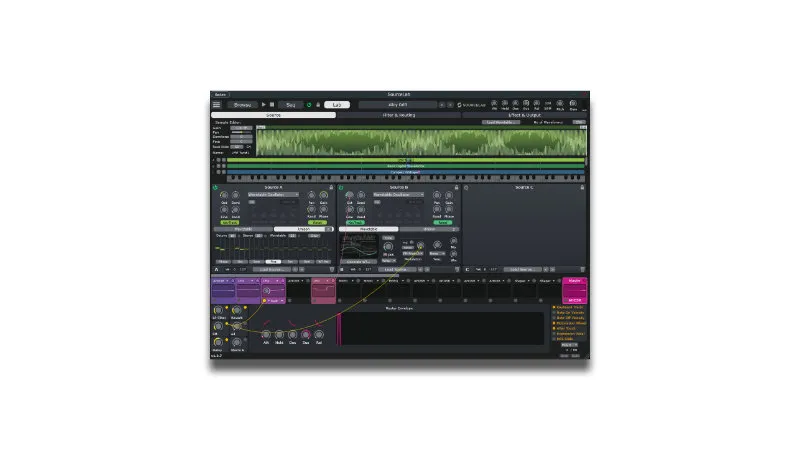
I participated in the development of Initial Audio’s Source Lab modular wavetable synthesizer as both a wavetable and preset designer.
During this process, I realized that Source Lab’s highly flexible unison engine serves as a “testing ground Efor sound design that transcends conventional boundaries. Sound designs that previously required multiple oscillators can now be achieved with just a single oscillator in Source Lab. From chord voicings and unison chords to adding sub-oscillators and even building complex ensembles utilizing up to 24 voices—all of this is achievable within a single oscillator module.
However, SourceLab doesn’t include preset unison modes like many commercial wavetable synthesizers, which might be less intuitive for beginners. To address this, I’ll recreate Ableton Wavetable’s unison modes in SourceLab, revealing the underlying structure of these common unison features.
2. Deconstructing Unison Parameters
In many wavetable synthesizers, you select a mode from a set of predefined unison presets, and editing is primarily limited to voice count and detune amount. SourceLab, on the other hand, allows you to individually set the pitch, phase, pan, and wavetable position for each voice.
This enables applications beyond standard unison use, such as chord voicings and sub-oscillator configurations, allowing you to achieve a wide range of sound design possibilities with just one oscillator module.
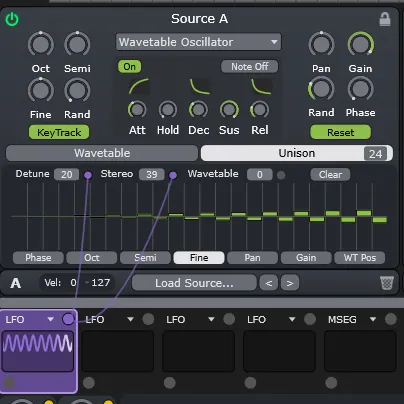
Oscillator Parameters Used for Unison
- Rand(Fine Pitch): Randomizes the fine pitch of each voice within the specified range.
- Rand(Phase): Randomizes the phase of each voice within the specified range.
Voice-Level Parameters:
- Voice Count: Sets the number of unison voices (1-24).
- Pitch (Octave / Semitone / Fine): Enables precise design ranging from frequency deviation (detune) for chorus effects to harmonic structures using perfect intervals.
- Phase: Offsetting the start phase of each voice to avoid unwanted destructive interference (phasing) at the attack or to emphasize specific textures.
- Pan & Gain: Defining the localization and volume balance of each voice within the stereo field.
- WT Pos (Wavetable Position): Introducing subtle variations in the wavetable readout position for each voice, adding complex layers to the timbre itself.
Global-Level Parameters:
- Detune(Fine Spread): A global detune control that affects all voices, spreading their pitches evenly. It allows you to quickly adjust the overall thickness of the sound.
- Stereo(Spread): A global stereo width control that adjusts the panning spread of all voices, enhancing the spatial characteristics of the sound.
- Wavetable(Spread): A global wavetable position control that shifts the readout position for all voices, enabling broad timbral changes with a single adjustment.

A notable feature is the dual-layer architecture: independent “micro-editing” of individual voices and “macro-control” via global sliders (Detune / Stereo / Wavetable). This structure achieves a high level of synergy between precise acoustic engineering and intuitive operation.
3. Understanding Phase Relationships
Phase Control and Waveform Characteristics in SourceLab
SourceLab’s Unison allows you to adjust the phase parameter up to 50% (180 degrees). At 0° and 180° offset relationship, the phases are inverted—for symmetrical waveforms like sine waves, the sound completely cancels out. However, with sawtooth waves, the odd harmonics are eliminated, leaving only even harmonics, resulting in a waveform that sounds one octave higher.
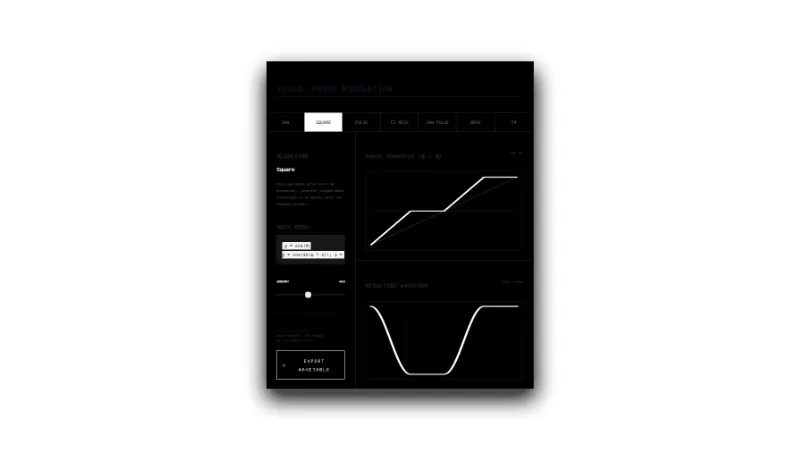
Additionally, when layering square waves at the same pitch and increasing one voice’s phase parameter, you achieve the same effect as Pulse Width Modulation (PWM). This occurs because the phase shift effectively changes the duty cycle.
Why “Evenly Spreading with Aligned Phases” Creates Beating
Prerequisites
- All unison voices start from identical waveforms and identical phases
- Each voice’s pitch is symmetrically and evenly detuned
While this setup appears “organized” and “stable,” it is physically the condition where beating becomes most apparent.
1. Aligned Phases = Maximized Amplitude Interference
When phases are perfectly aligned, each voice’s peaks and troughs occur at the same moments. Slightly different frequencies create periodic constructive/destructive interference—this “periodic amplitude fluctuation” is what we perceive as beating.
2. Even Detuning Creates “Regular Pulses”
With symmetrical, evenly-spaced detuning (e.g., ∁E/0/+5 cent or ∁E0/∁E/+5/+10 cent), the frequency differences between voices become constant intervals. Beat frequencies align, creating periodic, emphasized amplitude modulation—essentially unintentional low-frequency AM.
3. Why Random Phase Suppresses “Beating”
Conversely, when you randomize each voice’s phase:
- The timing of each voice’s peaks and troughs becomes offset
- Interference patterns become aperiodic and complex
- Regular constructive/destructive interference at specific frequencies is dispersed
- As a result, it’s perceived as smooth “thickness” rather than distinct “beating”
SourceLab allows for precise acoustic design by offering both intentional phase alignment and controlled randomization.
3.5. Technical Insights: Randomization and Unison Interaction
During the preparation of this article, I had the opportunity to receive technical insights directly from the SourceLab developer. The Random (Rand) knobs located in the top section of the Oscillator are designed with the premise of working in conjunction with the unison engine.
“Random Fine Tune is designed for unison. With it, you get the same thickness as random phase but you keep the sharp attack. With random phase, the attack always becomes softer.” — SourceLab Developer
Understanding this characteristic clarifies the criteria for selecting unison textures:
- Random Phase: Applied to all unison voices to prevent phase interference. Suitable for situations requiring a gradual onset, such as pad or string-type sounds.
- Random Fine (Fine Rand): Maintains equivalent thickness while preserving a clear and sharp attack. Effective for sounds where the attack component is critical, such as leads, plucks, and bass tones.
4. Expanding Unison: From Ableton Wavetable to SourceLab
Classic Mode
Structure: The oscillators are detuned with equal spacing and panned to alternating stereo channels.(Ableton Manual)
Technique: Rand (Phase) is increased to a desired level, with the effect further shaped by adjusting the Detune (Fine Spread) and Stereo Spread parameters.
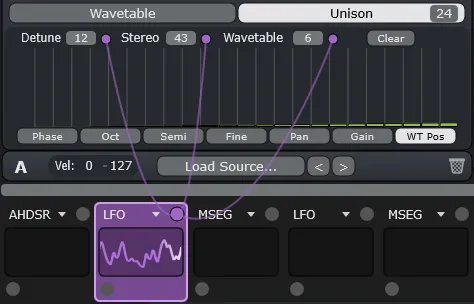
Shimmer Mode / Noise Mode
Structure: The oscillator pitches are jittered at random intervals, giving a shimmering reverb-like effect. A small amount of wavetable offset is also applied for extra fullness.(Ableton Manual)
Technique: (Shimmer): A random-shaped LFO is assigned to modulate Detune (Fine Spread) and Wavetable Spread. (Noise):Based on the Shimmer setup, the same LFO is set to a much faster rate to achieve the effect.
Phase Sync Mode
Structure: The oscillators are detuned as in Classic unison mode, but the phases are synced when a note is started giving a strong sweeping phaser-style effect.(Ableton Manual)
Technique: The overall setup is almost identical to Classic, but all voices have their Phase tabs set to the same value.
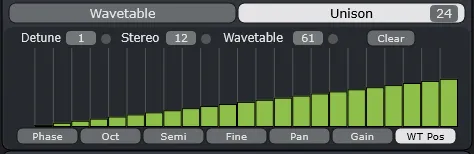
Position Spread Mode
Structure: The wavetable positions for each oscillator are evenly spread out by an amount. A small amount of detune is additionally applied for extra width.(Ableton Manual)
Technique: The sound is shaped mainly by adjusting Wavetable Spread and Stereo Spread, with a small amount of Detune (Fine Spread) and Rand (Fine Pitch) added for extra width.
Random note
Structure: The wavetable positions and detune amount for each oscillator are randomised each time a note is started.(Ableton Manual)
Technique: Assigning an LFO to modulate Rand(Fine Pitch) and Rand (Phase) ensures that a new random value is generated for each Note-On event.
5. Advanced Unison and FM Sound Design in SourceLab
Building on the Ableton Wavetable unison setup described in the previous section, you can achieve an even wider variety of sounds by further adjusting each voice individually. For example, one voice can be pitched down by an octave and set to mono to function as a sub oscillator, or a seventh interval can be added to create harmonic unison textures. Alternatively, instead of spreading the fine-tune values evenly across voices, you can apply random pitch offsets to create unsettling, unstable textures that add tension and unpredictability to your sound.
An even more interesting sound design approach is to use the entire unison as an FM modulation source. Since SourceLab supports stereo FM, rich and expressive sounds can be generated using only two oscillators. Especially when combined with FM, this approach allows you to achieve complex timbres that would normally require multiple oscillators, using a minimal setup.

6. Conclusion
Unison extends beyond simple voice layering—it’s about understanding how multiple voices interact acoustically. By grasping the parameters and principles behind each voice, you can move beyond preset limitations and explore more intentional sound design.
This article examined how SourceLab’s voice-level control allows you to recreate classic unison modes and experiment with techniques like sub-oscillator layering, harmonic voicings, and phase relationships. These principles can be applied across different synthesizer platforms.
Exploring these unison concepts opens up new possibilities for designing pads, leads, and experimental textures.
Featured Product: Source Lab
I contributed to Source Lab as a wavetable and preset designer. The synthesizer reflects the voice-level design approach discussed in this article.
The link below is an affiliate link—purchases through it provide a small commission that supports my work, at no additional cost to you.